
Discoveries of Subatomic particles by scientists
Match the following
- a) Neutron – 1) Rutherford, 1909
- b) Electron – 2) James Chadwick 1932
- c) Proton – 3) JJ Thomson, 1897
- d) Atom – 4) John Dalton 1808
(A) 2 3 1 4
(B) 1 2 3 4
(C) 1 4 2 3
(D) 2 3 4 1
EXPLANATION
a) Neutron – 2) James Chadwick, 1932
-
Explanation:
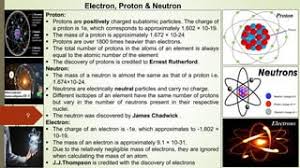
James Chadwick discovered the neutron in 1932.
The neutron is a neutral particle found in the nucleus of atoms. Before its discovery, the atomic mass didn’t match the number of protons alone, so the existence of a neutral particle was suspected. Chadwick’s experiments confirmed it.
b) Electron – 3) J.J. Thomson, 1897
-
Explanation:
J.J. Thomson discovered the electron in 1897 using a cathode ray tube.
He showed that cathode rays were made of negatively charged particles, which he called corpuscles (now called electrons). This was the first discovery of a subatomic particle.
c) Proton – 1) Rutherford, 1909
-
Explanation:
Ernest Rutherford discovered the proton around 1909 during his gold foil experiment.
He observed that atoms have a small, dense, positively charged center, which was later identified as the proton. His work also led to the nuclear model of the atom.
d) Atom – 4) John Dalton, 1808
-
Explanation:
John Dalton proposed the atomic theory in 1808.
He suggested that all matter is made of small indivisible particles called atoms, each element having its own kind of atom. Though not entirely accurate today, it laid the foundation for modern chemistry.
✅ Correct Answer: (A) 2, 3, 1, 4


Leave a Reply
Want to join the discussion?Feel free to contribute!